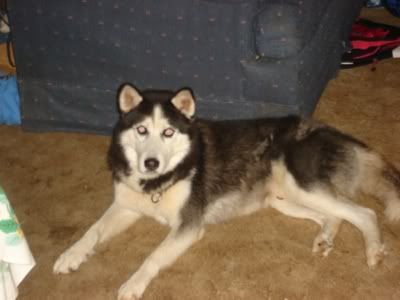
There are lots of stories about unusual, unique, or just plain funny animals in the world around us, whether they are pets, working animals, or in the wild. This section will highlight some of those animals. Check back often to see what is new, and if you have any heartwarming, interesting, or mysterious animal stories to share, please let us know!

Return to Waldorf Kennels and Gardens Home

Friday, May 27, 2011

Heroic Rescue of Elderly Couple by Their Half-breed Wolf Dog

Eve and Norman Fertig treat and rehabilitate injured animals at Enchanted Forest Wildlife Sanctuary located on their property in Alden, New York.  This story is about how one of the animals paid them back by saving their lives.


In 2000, Eve and Norman rescued a tiny, sick half wolf, half German Shepherd puppy from a breeder.  On October 12, 2006, Shana weighed a powerful 160 lbs.  That night a massive snowstorm with high winds hit upstate New York.

It was the routine for the 81-year-old Fertigs to feed and exercise the animals in the sanctuary around 7pm each night.  While in the building, the lights went out and they realized that something was wrong.  When they went outside to see what was going on a huge tree fell down on them, and other trees fell with it, effectively blocking their way to the other sanctuary buildings and their house, which was about 200 feet away.

The Fertigs huddled in a narrow alley between two buildings.  They were sheltered from falling trees, but not from the cold.  They could not climb over the trees, so they were trapped. "We were in big trouble. … I said to my husband, 'I think we could die out here,'" Eve said.

Shana found the Fertigs and began burrowing under the trees to reach them, and tunneling through the snow to reach the house.  This took her until about 11:30pm.  Then Shana came back, threw the 86-lb. Eve on her back, and dragged Norman, who held onto Eve’s legs.  It took her until 2am to reach the house.   

When they reached the house the Fertigs fell inside the door and Shana laid on top of them to keep them warm.  There was no electricity or heat in the house, and they laid there until the fire department found them.

For her efforts, Shana received the Citizens for Humane Animal Treatment's Hero's Award, which is generally an award given to humans. 

Eve Fertig teaches others to be wildlife rehabilitators.  She and Norman are volunteers, and pay for caring for the sanctuary animals out of their social security checks.  Donations may be sent to Mrs. Eve Fertig, Enchanted Forest Wildlife Sanctuary, 11380 Cary Road, Alden, N.Y. 14004-9547.

This summary was taken from a FOXNews story by Liza Porteus http://www.foxnews.com/story/0,2933,234599,00.html which has many more interesting details about this amazing rescue.

“God is watching; he's watching all the time," Eve Fertig told FOXNews from her home at the Enchanted Forest Wildlife Sanctuary in Alden, N.Y.

Friday, May 20, 2011

Dogs Can Accurately Sniff out Early Stage Bowel Cancer

ScienceDaily (Feb. 1, 2011) — Dogs can sniff out bowel cancer in breath and stool samples, with a very high degree of accuracy -- even in the early stages of the disease -- reveals research published online in the journal Gut.

The findings prompt the authors to suggest that chemical compounds for specific cancers circulate throughout the body, which opens up the prospect of developing tests to pick up the disease before it has had the chance to spread elsewhere.


A specially trained Labrador retriever completed 74 sniff tests, each comprising five breath (100 to 200 ml) or stool samples (50 ml) at a time, only one of which was cancerous, over a period of several months.

The samples came from 48 people with confirmed bowel cancer and 258 volunteers with no bowel cancer or who had had cancer in the past.

Around half of the volunteer samples came from people with bowel polyps, which although benign, are considered to be a precursor of bowel cancer. And 6% of the breath samples and one in 10 of the stool samples from this group came from those with other gut problems, such as inflammatory bowel disease, ulcers, diverticulitis, and appendicitis.

The bowel cancer samples came from patients with varying stages of disease, including early stage.

The dog successfully identified which samples were cancerous, and which were not, in 33 out of 36 breath tests and in 37 out of 38 stool tests, with the highest detection rates among those samples taken from people with early stage disease.

This equates to 95% accuracy, overall, for the breath test and 98% accuracy for the stool test, compared with conventional colonoscopy -- a procedure involving a tube with a camera on the end inserted through the back passage.

Samples from smokers or from those with other types of gut problems, which might be expected to mask or interfere with other smells, did not pose a problem for the dog.
This indicates that there are specific discernible odours given off by cancer cells which circulate around the body, say the authors. And it is backed up by other research and anecdotal evidence indicating that dogs can sniff out bladder, skin, lung, breast and ovarian cancers, they add.

The authors concede that using dogs to screen for cancers is likely to be impractical and expensive, but a sensor could be developed to detect the specific compounds.

The faecal occult blood test, which picks up hidden blood in a stool sample is an effective and non-invasive method of screening for bowel cancer, say the authors, but it is only able to pick up early stage disease in one in 10 cases.
"Early detection and early treatment are critical for the successful treatment of cancer and are excellent means for reducing both the economic burden and mortality [of bowel cancer]," comment the authors.
________________________________________
Story Source:
The above story is reprinted (with editorial adaptations by ScienceDaily staff) from materials provided by BMJ-British Medical Journal, via EurekAlert!, a service of AAAS.
________________________________________
Journal Reference:
1. Hideto Sonoda, Shunji Kohnoe, Tetsuro Yamazato, Yuji Satoh, Gouki Morizono, Kentaro Shikata, Makoto Morita, Akihiro Watanabe, Masaru Morita, Yoshihiro Kakeji, Fumio Inoue, Yoshihiko Maehara. Colorectal cancer screening with odour material by canine scent detection. Gut, 31 January 2011 DOI: 10.1136/gut.2010.218305

Friday, May 13, 2011

Therapy Dogs Can Help Patients Anxious About Having an MRI

Patients who have an MRI often experience anxiety during it, and this can lead to poor image quality.  Patients may move, or may even end the procedure early due to their anxiety.  Currently, anti-anxiety medications are used to calm patients, but animal-assisted therapy may be a viable alternative.  An exhibit is being presented at the 2011 American Roentgen Ray Society's annual meeting.

The project was conceived by a fifteen-year-old high student. During the course of her MRI, Allison Ruchman experienced anxiety and claustrophobia. She quieted her emotions by thinking about her dog, Wally.  She believed that her experience could apply to other patients.

Allison became a certified dog therapist, and conducted the research on this project, assisting physicians who did a study at Monmouth Medical Center in Long Branch, NJ. Twenty-eight patients interacted with a certified therapy dog at various levels of intensity for fifteen minutes, approximately thirty minutes prior to their MRI. Six patients underwent no intervention for the same period of time.

"The most significant aspect of our findings was the fact that time spent with a dog (animal-assisted therapy) could substitute for pharmacologic anxiolysis (anti-anxiety medication) often needed to assist patients having an MRI," said Richard Ruchman, MD, one of the authors of the study.

"A great deal of research is currently being conducted on animal assisted therapy in the medical environment. To my knowledge, this is the first study that has particularly addressed animal-assisted therapy in the radiology department, and I believe that many applications of could flow from our findings. Current estimates are that 15% or more of patients cannot proceed with an MRI due to anxiety and a non-pharmacologic solution is noteworthy," said Dr. Ruchman.

Story Source:

The above story is from materials provided by American Roentgen Ray Society, via EurekAlert!, a service of AAAS.